The Tytherington Club

Men’s Singles Knock-Out – New Format Explained
Why has the format changed?
The men’s singles knock-out has been redesigned following direct feedback primarily from both lower-handicap and higher-handicap players.
At a local level, members at opposite ends of the handicap range have shared similar frustrations with traditional knock-out match play under the World Handicap System (WHS). At the same time, these concerns reflect a wider national issue affecting clubs across the country.
This change is therefore being introduced as a local trial for the 2026 season, shaped by our own members’ feedback and informed by an understanding of the national challenges currently facing knock-out golf.
---
The wider issue with WHS and match play
Under WHS, match play uses 100% of the handicap difference.
While this complies fully with the system, many clubs have found that it has reduced enjoyment and participation, particularly in knock-out competitions. Concerns raised by clubs nationally have led to very little flexibility or adaptation within WHS itself.
Rather than waiting for a national solution, Tytherington has chosen to explore a club-level approach that remains within the Rules of Golf while better reflecting how our members experience match play.
---
What alternatives were considered?
One commonly used alternative at other clubs is the introduction of handicap limits.
While this can reduce extreme handicap differences, it also means excluding players. With 51 entrants in the 2025 men’s singles knock-out at Tytherington, we are not currently in a position to reduce numbers further.
We need more players, not fewer.
Some clubs are fortunate enough to have significantly higher entry numbers and can successfully operate handicap-restricted competitions. Maybe one day we will be in that position — but the reality is that their competitions are currently better supported than ours.
2025 Men’s Singles KO – Handicap Breakdown
Total entrants: 51
0–5 handicap
* 6 players
* 11.8%
5.1–12 handicap
* 28 players
* 54.9%
12.1–18.9 handicap
* 13 players
* 25.5%
19+ handicap
* 4 players
* 7.8%
---
What this shows clearly
* Over half the field (54.9%) sat between 5.1 and 12.
* Only 4 players (7.8%) were 19 or higher.
* Just 6 players (11.8%) were 0–5.
So nearly 63% of the field (32 out of 51) were between 0 and 12 handicap.
Meanwhile, genuine higher handicappers (19+) made up less than 1 in 13 entrants.
---
Why this supports the trial
The data shows:
* Strong engagement in the 5–12 range
* Very limited participation at the upper end (19+)
* Relatively modest participation at the very low end (0–5)
If the aim is to grow the competition, the opportunity clearly sits at:
* Increasing participation from 19+ golfers
* Encouraging more 0–5 golfers to enter
The middle band is already well represented.
---
Why this format was chosen
This format provides the benefits of balanced match play without excluding anyone.
No handicap limits
No reduction in entry numbers
No reliance on luck of the draw
Instead, early rounds are played within handicap groups, meaning everyone enters with the same realistic chance of winning.
---
A note on different handicap experiences
One important point to recognise is that mid-handicap players will feel the least impact from this change.
Mid handicappers are rarely stuck at either extreme of the handicap spectrum. They are not consistently giving very large numbers of shots, nor are they always receiving them.
By contrast, lower handicappers often report fatigue from always having to give shots, while higher handicappers can feel defined by always receiving shots.
Over time, that dynamic can become mentally draining for both sides. Golf should not feel like you are permanently playing from one psychological position or another. A healthier competitive balance benefits the mindset of all players, not just the scorecard.
---
How the structure will work
Based on 2025 entry numbers, the likely structure would be four handicap groups.
Each group produces a winner.
The Group 1 winner plays the Group 2 winner in one semi-final.
The Group 3 winner plays the Group 4 winner in the other semi-final.
The final structure will always be determined by the number of entries, allowing the competition to remain balanced and well supported.
---
A trial for 2026 – and a request to members
This format will run as a trial for the 2026 season.
Yes, it is a change, but it is a change made with the intention of improving fairness, enjoyment, and participation.
With 2026 being Tytherington’s 40th anniversary year, and with the course fully open, we encourage all members to support club competitions and help make this a standout season.
Please keep an open mind, give the format a try, and judge it based on experience. Feedback will be welcomed once the trial has run its course.
Golf is a game we should all enjoy, and this trial is about protecting that enjoyment for as many members as possible.
How 2025 could have looked
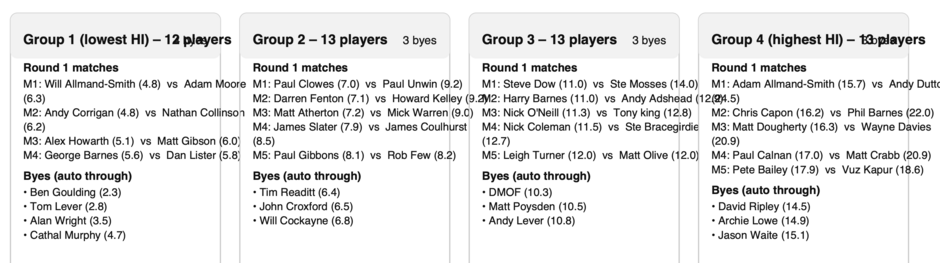
From reviewing the table, it is clear that the 2025 entry list is heavily concentrated in the middle handicap ranges. Groups 2 and 3 cover relatively narrow handicap bands, while there are noticeably fewer entrants at both the lower and higher ends of the spectrum shown by wider handicap bands. This suggests that participation is currently strongest among mid-handicap golfers, with under-representation from both low-handicap and higher-handicap players. This distribution further supports the need to trial a revised format that encourages greater confidence and participation at both ends of the handicap range, with the aim of growing overall entry numbers rather than restricting them.
---
Entry requirement reminder
To enter the men’s singles knock-out, players must still meet the existing eligibility requirement.
A minimum of 5 handicap-qualifying rounds played at Tytherington within the last 12 months.
This requirement applies to all entrants and remains unchanged.
Created by intelligentgolf version 10.1.2.
© 2026 The Tytherington Club / 01625 506 000
© 2026 intelligentgolf. CONGU is ® Council of National Golf Unions
© 2026 intelligentgolf. CONGU is ® Council of National Golf Unions